




Warming up your home with a thermal camera
Some simple repairs changed my house from chilly to cosy, and - a bonus - during summer it stayed 4C cooler than the previous year!
Here at Pangloss Labs one of the tools we have available is a thermal camera. This one measures from -40C to +550C with a 240x320 thermal resolution. We use it for tuning machining profiles, checking 3D printers, electrical wiring, electronic fault-finding and more. But when the weather is cold, it's extremely useful around your home, to find those little cold patches that turn your home from cosy to chilly, no matter what temperature you have the heating set to.
Last winter, I took the thermal camera home to see what was going on in my home in the Pays de Gex, a terraced house built in the mid 1980s.
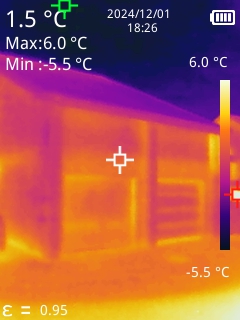
Looking from outside, we can see that heat leaks around the garage door. Not unexpected. We can see that my neighbours newer garage door is better insulated than mine. We can see that the roof insulation is OK. You can also see where the floor and/or ceilings meets the walls. Some heat is lost there due to thermal bridge effects.
Not a lot to do here. The garage isn't heated so I don't worry.
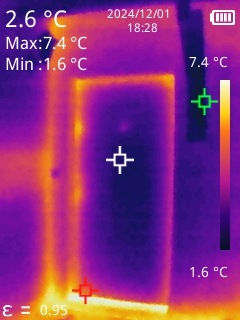
Looking at the front door - again from outside - we can clearly see heat leaking all around the door. I had thought that the door just let the cold through it, but this was additional. I clearly needed to replace the seals around the door and pay special attention to the bottom of the door.
Fix
- Purchase new sealing strips
- Remove old seal
- Fix new seal into place
Result
- Feeling of cold near the front door gone. The entrance feels warm when we come home in winter.
Moving inside the house, I found that all of the lighting points upstairs looked like this. The blue shows the cold coming into the house in a continuous stream.
Fix
- Bought sealed light fittings
- installed them into ceiling, using new pluggable lamp sockets
Result
- Cold gone under each light fitting,

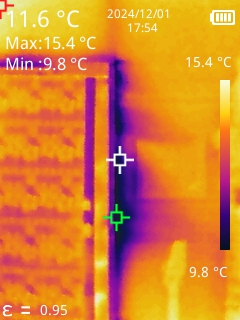
This is a full length window that opens like a door. Looking from inside I found that the window seals - so warm when we moved in 20 years ago, were now leaking. Further investigation found that they had harded over time, making a worse and worse seal when the windows were closed. Not much, but enough to see with the camera.
Worse - and this was something I found around every door and window frame - You can see that there is cold leaking in around the window frame. This was the worst example in the house, but every door and window had this to some extent.
Fix
- Purchase new insulating strips for the windows
- Fit them to every single window and door
- Use paintable silicone sealant to seal around every window and door frame

- I was afraid that this would be a thermal bridge problem and that nothing could be done without replacing my windows, so I tried a simple solution first. This thermal image is what happened when I simply put blue painters tape around the window frame. You can see it significantly limited the cold coming in. This game me the confidence to seal around them all.
Result
- No feelings of cold any more around any window or door.
Conclusion
I spent around 2 hours with the thermal camera and some blue painters tape. I even found some electrical sockets which leaked cold air into the house.
With a combination of sealing strip, silicone paintable sealant, and some sealed light fittings, all purchased from a local DIY shop for around 200 euros, I made my house a lot more comfortable this winter. And as an unexpected bonus, it stayed a lot cooler in summer too!
Pangloss members can take the thermal camera home for a weekend plus an evening (to check up after you fixed things) for only 10 euros. Best to do so in the winter months.
Warning: when sealing up drafts in your home, be sure to maintain your home's intended ventilation and not block up the needed air inlets. Sealing your home completely will lead to mould if you don't have a bidirectional VMC.


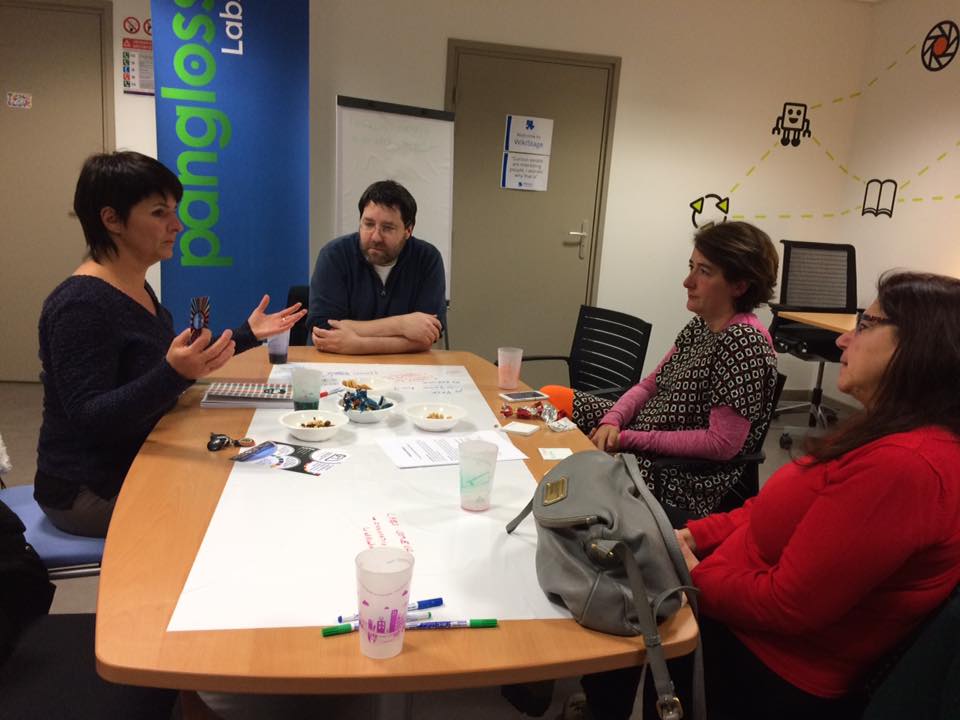
 On the 12th of January a small, determined group met at Pangloss Labs in Ferney-Voltaire to discuss why there isn't yet a Pangloss Labs Geneva site and what to do about it.
In a nutshell, although we have found some spaces in Geneva that meet our original half office / half workshop criteria, they are very few and far between. With the rent costs being much higher in Geneva than neighbouring France, to replicate directly what we did in France would need 45 people willing to pay a proportion of the rent, before we have the space. In addition, leases in Geneva tend to start at 5 years. With some of the offers we have, on projects under development, we'd need 45 people willing to commit to contribute to a collaborative association for 5 years, starting in 1-2 years time. That's almost impossible to do.
So, with the facts on the table, and with the aid of some decent French wine, we brainstormed on the possible ways forward.
On the 12th of January a small, determined group met at Pangloss Labs in Ferney-Voltaire to discuss why there isn't yet a Pangloss Labs Geneva site and what to do about it.
In a nutshell, although we have found some spaces in Geneva that meet our original half office / half workshop criteria, they are very few and far between. With the rent costs being much higher in Geneva than neighbouring France, to replicate directly what we did in France would need 45 people willing to pay a proportion of the rent, before we have the space. In addition, leases in Geneva tend to start at 5 years. With some of the offers we have, on projects under development, we'd need 45 people willing to commit to contribute to a collaborative association for 5 years, starting in 1-2 years time. That's almost impossible to do.
So, with the facts on the table, and with the aid of some decent French wine, we brainstormed on the possible ways forward. 


 The
The 


 Lots of small autoentrepreneur changes came in on January 1st, with the most important one being that now you must have a separate bank account for your autoentrepreneur business.
Good news in that social charges have reduced, and a new requirement for using online tools for uploading your accounts if your turnover exceeds a certain threshold.
More details at the
Lots of small autoentrepreneur changes came in on January 1st, with the most important one being that now you must have a separate bank account for your autoentrepreneur business.
Good news in that social charges have reduced, and a new requirement for using online tools for uploading your accounts if your turnover exceeds a certain threshold.
More details at the 


